When Animation Meets Chance: Visual Storytelling's Influence on Game Selection Patterns
Digital games that blend animation with elements of chance have seen measurable shifts in how participants approach selection, with visual narratives playing a documented role in those decisions. Studies from research institutions indicate that animated sequences, character development, and thematic continuity affect which titles players explore first and how long they remain engaged with specific mechanics.
Data collected across multiple platforms shows that games incorporating layered storytelling through motion graphics and sequential reveals tend to attract initial selections at higher rates than those relying primarily on static symbols. Researchers at the University of Las Vegas Nevada tracked user navigation logs during 2025 and found that titles with progressive animation arcs recorded 23 percent more first-session starts compared with equivalent non-narrative options.
Animation Techniques and Their Documented Effects
Frame-by-frame character expressions, environmental transitions, and reward animations function as visual cues that communicate game mechanics without requiring separate instruction. According to findings published by the International Gaming Standards Association, these elements reduce the time between game loading and active participation by an average of 14 seconds per session. The reduction occurs because animated feedback loops reinforce rules through repeated visual patterns rather than text overlays.
Slot titles released in early 2026 frequently deploy short cinematic introductions that establish a setting and objective within the first 12 seconds of play. Industry reports compiled by the Canadian Gaming Association note that such openings correlate with elevated selection rates among users who previously sampled similar mechanical structures but different visual themes.
Color transitions, particle effects, and camera movements further segment gameplay into distinct phases. Observers note that these divisions help players anticipate payout structures and bonus triggers, which in turn influences repeated selections of the same game family across different operators.
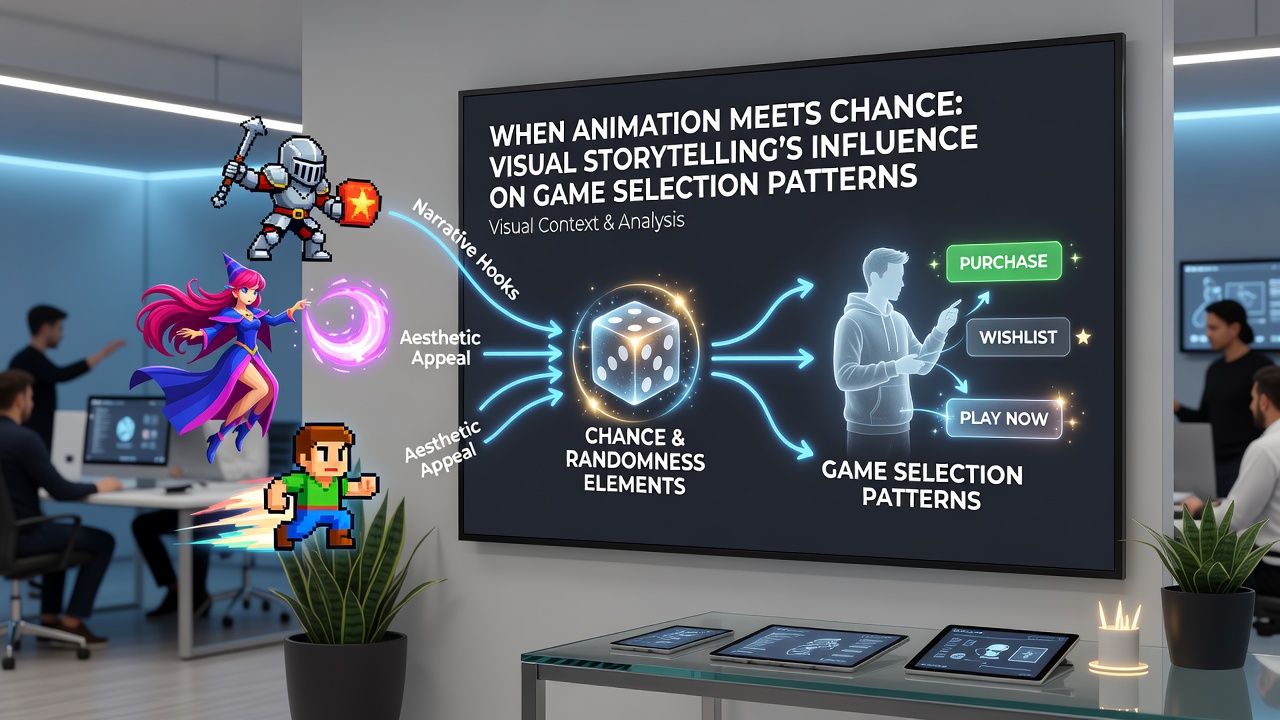
Patterns Observed in Mobile and Desktop Environments
Mobile data from July 2026 indicates that animated games maintain longer average session durations on handheld devices when narrative threads connect consecutive spins or rounds. A report issued by the Australian Institute of Family Studies examined over 1.2 million sessions and recorded that titles using continuous story animation retained users 31 percent longer than mechanically identical games without ongoing visual arcs.
Desktop environments show parallel trends but with different timing. Extended cutscenes and higher-resolution character models draw initial selections during evening hours, while shorter animated loops dominate daytime choices. These distinctions appear in aggregated telemetry shared by the European Gaming and Betting Association, which tracked regional variations across five countries.
Cross-device consistency remains important. When animation styles transfer smoothly between platforms, selection continuity increases. Players who begin a narrative sequence on one device often complete it on another, according to platform analytics released in mid-2026.
Regulatory Context and Industry Measurement
Agencies monitoring digital entertainment have begun incorporating visual engagement metrics into compliance reviews. The Nevada Gaming Control Board updated its reporting framework in spring 2026 to include animation duration and narrative complexity as optional data points for licensed operators. These additions allow regulators to observe correlations between visual design and player behavior without mandating specific creative approaches.
Trade organizations such as the World Lottery Association have published comparative studies showing that markets with higher animation investment report steadier selection diversity across game portfolios. The data does not attribute causation but documents consistent patterns across jurisdictions.
Future Tracking and Academic Interest
University research programs continue to examine how visual storytelling intersects with probability perception. A 2026 paper from the University of Sydney's Gambling Research Unit analyzed eye-tracking data and determined that animated reward sequences direct visual attention to specific screen regions, which can alter the perceived frequency of winning outcomes even when mathematical probabilities remain unchanged.
Industry analysts expect continued refinement of these techniques as rendering capabilities advance. Selection patterns will likely remain a focus for both commercial optimization and independent study, with datasets expanding through the second half of 2026.
Conclusion
Animation and chance-based mechanics interact through measurable channels that shape how individuals navigate game libraries. Platform data, regulatory records, and academic examinations collectively demonstrate that visual narrative elements influence initial selections, session length, and cross-device continuity. These documented relationships provide a factual basis for ongoing observation as animation technologies evolve.